

Acceptance and Commitment Therapy (ACT): what it is, who it helps and how it works.
A plain-English guide from the clinicians at Eunoia Health, led by Albie Mew-Davies, a BACP-registered therapist who specialises in ACT.
BACP-registered
〰️
No GP referral needed
〰️
Online or in person
〰️
No waiting lists
〰️
Free Consultation
〰️
BACP-registered 〰️ No GP referral needed 〰️ Online or in person 〰️ No waiting lists 〰️ Free Consultation 〰️
Most people who come to us have already tried to think their way out of a feeling. They have reasoned with it, outworked it and distracted themselves from it, and found that it returns, usually when they are tired. Acceptance and Commitment Therapy begins from a different place. This page explains what ACT is, who it suits, why it works, when to start, and what it looks like with us.
What is Acceptance and Commitment Therapy?
Acceptance and Commitment Therapy, usually shortened to ACT (said as the word "act"), is a form of psychotherapy that helps you change your relationship with difficult thoughts and feelings instead of fighting to remove them. It belongs to the third wave of cognitive behavioural therapies. Its aim is psychological flexibility: the ability to stay in contact with the present moment and to act on what matters to you, even when things feel hard.
ACT was developed by the American psychologist Steven C. Hayes and colleagues from the 1980s onwards, and set out as a full treatment in the 1999 manual by Hayes, Strosahl and Wilson. It is now practised internationally and has been tested in a large body of controlled trials.
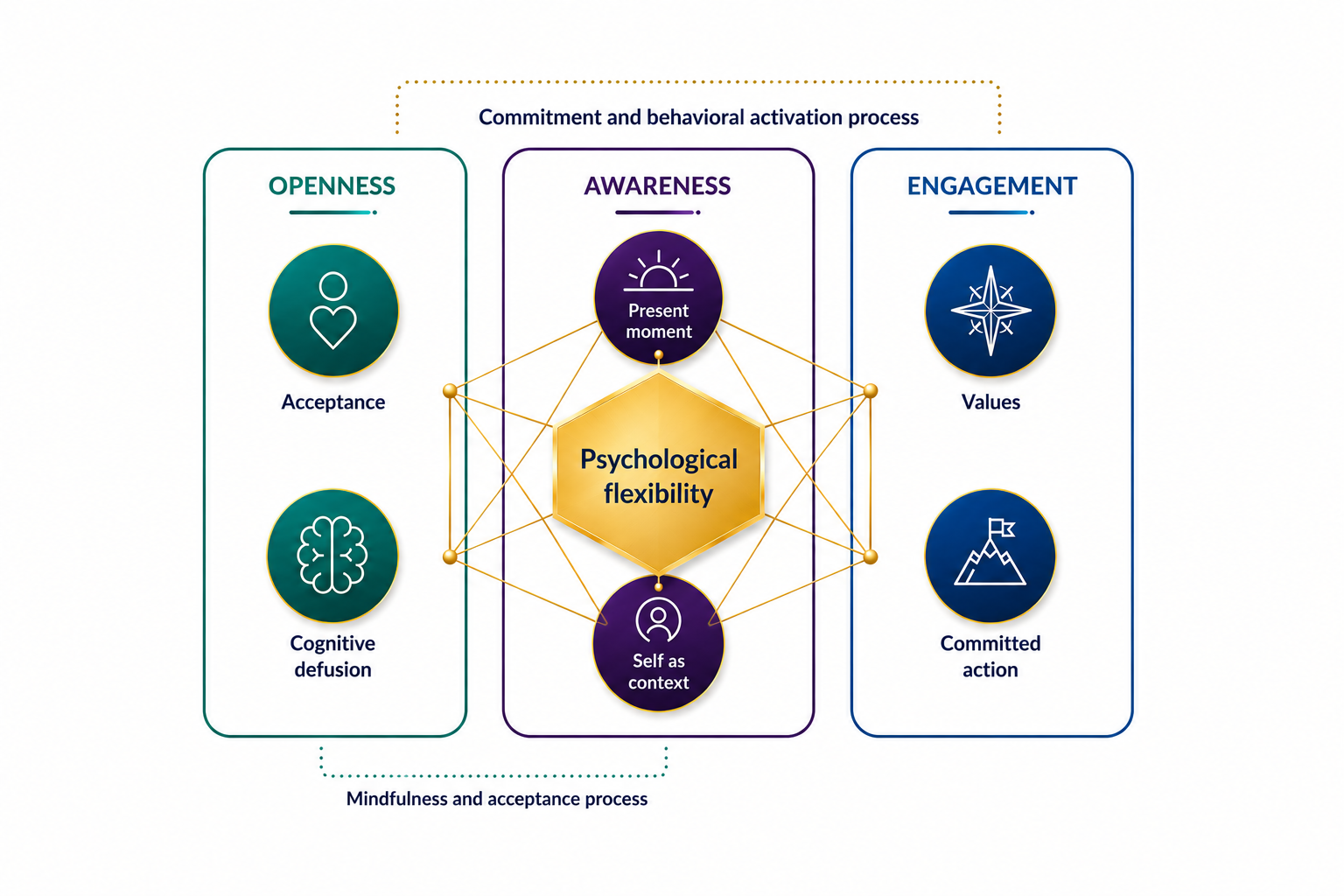
The six processes at the centre of ACT
ACT work is organised around six connected skills, often drawn as a hexagon called the Hexaflex.
Acceptance is making room for a feeling instead of struggling with it.
Defusion is stepping back from a thought so that you see it as a thought, not as a fact or an instruction.
Contact with the present moment is noticing what is happening now, rather than living in prediction or replay.
Self-as-context is the steadier sense of yourself that notices your thoughts and feelings without being defined by them.
Values are what you want your life to stand for, chosen by you rather than inherited.
Committed action is taking steps in the direction of those values, however small, while the difficult feelings are still there.
None of these asks you to feel better first. Together they build psychological flexibility, which is the thing ACT is trying to change.
Who is ACT for?
ACT is used with adults for anxiety, OCD, low mood and depression, stress and burnout, grief, sleep difficulties, and long-term health problems such as chronic pain. It tends to suit people who are managing well on the outside and carrying more on the inside.
You might recognise yourself if you spend a great deal of effort trying to control a feeling and it is not working, if you are putting parts of your life on hold until the anxiety or low mood clears, if you avoid things that matter to you because they are uncomfortable, or if you are doing all the right things and still feel stuck. If two or more of these sound familiar, it is worth a conversation.
ACT is often used alongside other approaches. For OCD, Albie combines ACT with exposure and response prevention (ERP), the form of CBT that NICE guidelines recommend for OCD.
ACT may not be the right fit if you are in an acute crisis, need urgent psychiatric care, or are looking for medication. Eunoia works with adults only and is not a crisis service. If you are in immediate danger, call 999. Samaritans are available at any time on 116 123.
Why does ACT work?
ACT works because much of what keeps distress going is the effort to get rid of it. Trying hard not to feel anxious, not to think a particular thought, or not to be reminded of a loss tends to make that experience louder and more central, and it often costs you the things you care about. ACT targets the struggle rather than the feeling.
This is not only a clinical impression. In a well-known series of experiments from the 1980s, Daniel Wegner and colleagues found that people who had first tried not to think about something later thought about it more, not less (Wegner et al., 1987). Psychologists call the wider pattern experiential avoidance, and it has been linked to a broad range of psychological difficulties (Hayes et al., 1996).
The research on ACT itself is substantial. A 2015 meta-analysis of 39 randomised controlled trials, covering 1,821 people with mental and physical health problems, found ACT more effective than waiting-list control, psychological placebo and treatment as usual, and not significantly different from CBT (A-Tjak et al., 2015). A 2020 review of 20 meta-analyses, drawing on 12,477 participants, concluded that ACT has shown efficacy across every condition examined, including anxiety, depression, substance use and pain. It generally outperformed inactive controls, treatment as usual and most active comparators, without outperforming CBT (Gloster et al., 2020).
It is worth being precise about guidelines. NICE recommends ACT as a treatment for chronic primary pain. For anxiety and OCD, NICE guidelines name CBT first, including exposure and response prevention for OCD. ACT sits in the same family of treatments, and the research above is why we use it as the foundation of our work, but we would rather tell you which recommendation is which.
When is the right time to start ACT?
The best time is usually earlier than people expect: when the effort of coping has started to cost more than the difficulty itself, and before something goes badly wrong.
You do not need a crisis or a diagnosis. People often come when they notice they are avoiding more, when they are tired of holding everything together, or after a loss, a change or a long period of pressure. ACT is a structured, time-limited therapy and is designed to end. We review progress with you regularly, and the aim is that you need us less over time, not more.
Where do you have ACT with Eunoia?
Online across the UK, by video, from wherever suits you. In person in Horsham, West Sussex, and at The Practice Rooms in Wimbledon, south-west London. The approach, the clinician and the length of session are the same in every format. Many clients choose online for the flexibility around work; if you are unsure which suits you, we can talk it through in the free chat.
How ACT works with Eunoia
It starts with a complimentary 15-minute chat with a BACP-registered therapist. There is no assessment and no obligation; it exists so that you can decide whether we are the right fit. If you go ahead, the first session is a 60-minute assessment in which your clinician builds a shared picture of what is happening, what it is costing you and what you want to be different. Sessions after that last 50 minutes. You work with one named clinician throughout, not a rotating match.
We use short questionnaires at the start and again later, including the GAD-7 for anxiety, the PHQ-9 for low mood and the Acceptance and Action Questionnaire, so that change is measured rather than assumed. Every six sessions we review whether the work is doing what it should.
Fees are explained in the free chat. We are recognised by Vitality, WPA, Healix Health, Healthcode, General & Medical Insurance and Allianz Partners, so if you have private health cover it is worth checking your policy.
Closing line above the button: Start with a conversation, not a commitment.
Who you will work with
Albie Mew-Davies is Eunoia's Clinical Lead and a BACP-registered therapist who specialises in ACT. He also trained in psychodynamic therapy, integrative practice and Jungian theory, delivers ERP for OCD, facilitates inpatient groups at the Priory Group, lectures at Canterbury Christ Church University and is the author of Beyond Not Knowing (2026).
Start with a conversation, not a commitment.
-
Acceptance and Commitment Therapy, usually shortened to ACT, is a form of psychotherapy that helps you change your relationship with difficult thoughts and feelings instead of fighting to remove them. It belongs to the third wave of cognitive behavioural therapies, and its aim is psychological flexibility: staying in contact with the present moment and acting on what matters to you, even when things feel hard.
-
Both belong to the CBT family and both are well researched. Traditional CBT often works by examining and changing the content of thoughts. ACT works on your relationship with those thoughts: you learn to notice them without obeying or arguing with them, and to act on your values while they are there. The aim is not to think more positively but to move towards what matters.
-
No. Acceptance in ACT is not resignation, and it does not mean tolerating a situation that can be changed. It means making room for a feeling you cannot remove, such as fear before a difficult conversation, so that it stops steering your decisions. Where something can be changed, ACT helps you change it.
-
A session is a structured conversation, not a lecture. Your clinician helps you notice patterns such as avoidance or over-control, and practise responding differently, usually starting with something specific that has been hard that week. Some sessions include short exercises in noticing thoughts and feelings, and you may be invited to try small experiments between sessions.
-
It depends on what you are bringing, so we agree a plan with you at the start and review it every six sessions. ACT is designed to be time-limited. The aim is that you need us less, not more.
-
NICE recommends ACT for chronic primary pain. For anxiety and OCD, NICE guidelines name CBT first, including exposure and response prevention for OCD. ACT has a substantial research base across these conditions and is the foundation of our work, but it is not the first-line NICE recommendation for them.
-
Yes. ACT has been studied for both. For anxiety it works on the avoidance and over-control that keep worry going. For OCD we combine ACT with exposure and response prevention (ERP), the form of CBT that NICE guidelines recommend for OCD.